Complete Guide to Laser Hair Removal: Everything You Need to Know
Everything you need to know about laser hair removal in Dubai — costs, sessions, skin types, and results. DHA-licensed doctors at Rere Polyclinic. Book free consult.
Byadmin
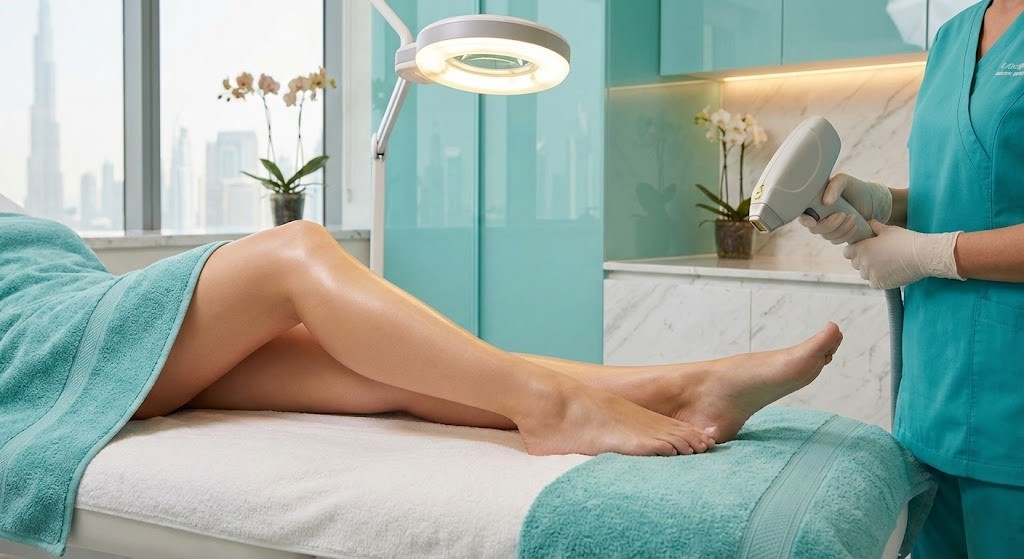
You’ve tried razors, waxing strips, threading, and every depilatory cream on the market.
Two weeks later — the hair is back.
For millions of people in Dubai and the UAE, laser hair removal has quietly become the most practical long-term solution for unwanted body and facial hair. The technology has advanced significantly. The results are now predictable, safe across diverse skin tones, and — when done by a DHA-licensed professional — almost entirely free of serious risk.
But the internet is full of conflicting advice. How many sessions do you really need? Does it work on dark skin? Is it painful? What does it cost in Dubai?
This complete guide answers every question — clearly, medically, and honestly — based on what our doctors at Rere Polyclinic Dubai Jumeirah 1 see in practice every week.
What Is Laser Hair Removal?
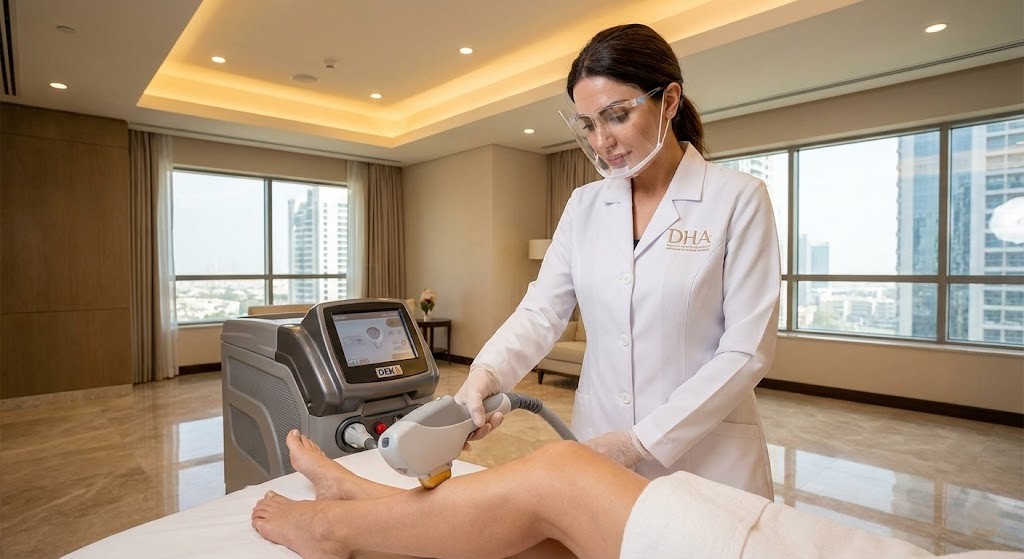
Laser hair removal uses concentrated light pulses absorbed by hair pigment to heat and destroy follicles, preventing future regrowth without damaging surrounding skin.
Laser hair removal is a non-surgical aesthetic procedure that uses a concentrated beam of light (laser) to target the melanin — or pigment — inside each hair follicle. The light converts to heat, which damages the follicle and disrupts its ability to produce new hair.
The key word is selective. Modern laser systems are designed to target only the dark pigment in the follicle while leaving the surrounding skin tissue completely unharmed. This is called selective photothermolysis — and it’s the scientific principle that makes the procedure safe and effective.
How laser energy works on a follicle: The laser targets hair in its active growth phase (anagen). Because not all hairs are in this phase at the same time, multiple sessions are required to catch every follicle at the right moment.
What Types of Lasers Are Used?
The most common laser types for hair removal are Alexandrite (fair skin), Nd:YAG (dark skin), and Diode — each suited to different skin tones and hair types.
The technology matters enormously. Different wavelengths of laser energy interact differently with melanin in both the hair and the skin.
Alexandrite (755nm): Fast and highly effective for fair to olive skin tones. One of the most widely used technologies for lighter skin types. Best for large areas like legs and back.
Nd:YAG (1064nm): The gold standard for medium to dark skin tones, including South Asian, Middle Eastern, and African skin. The longer wavelength bypasses surface melanin and targets only the follicle — making it the safest option for darker complexions.
Diode (800–810nm): A versatile mid-range option that works across a wide range of skin types. Combines speed with precision.
At Rere Polyclinic, our medical team selects the appropriate laser system based on your Fitzpatrick skin type, hair color, hair thickness, and treatment area — because there is no one-size-fits-all approach to laser hair removal.
Does Laser Hair Removal Work on Dark Skin?
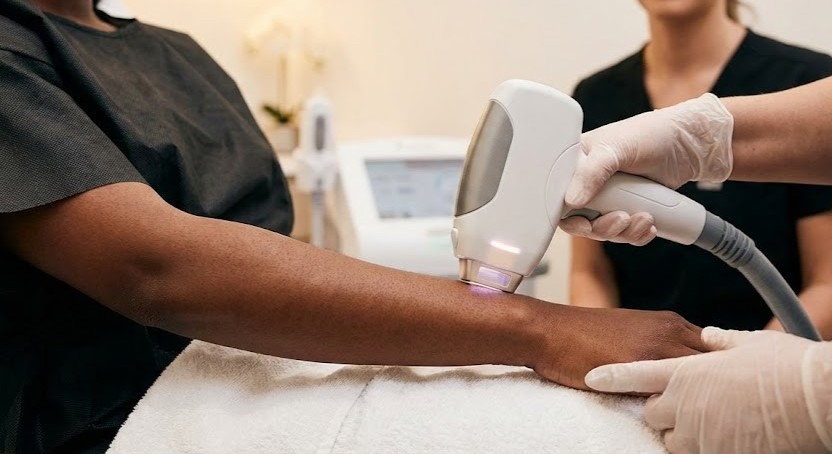
Yes — Nd:YAG lasers safely and effectively treat dark skin tones, including South Asian and African skin, without burning or causing hyperpigmentation when done correctly.
This is one of the most important questions — and one of the most misunderstood.
Older laser technology did pose risks for darker skin tones. Early systems couldn’t differentiate effectively between melanin in the skin and melanin in the hair follicle. But that era is over.
Nd:YAG lasers (1064nm) have a longer wavelength that penetrates deeper, bypassing the surface skin pigment and targeting the follicle directly. In the hands of a trained and DHA-licensed practitioner — who knows how to adjust fluence, pulse duration, and spot size — Nd:YAG laser hair removal is both safe and effective for Fitzpatrick Types V and VI.
In Dubai’s multicultural population, this matters more than almost anywhere else in the world. Our clinic sees patients from South Asia, East Africa, the Levant, and Southeast Asia daily — and we treat all skin tones safely using the correct technology and clinical protocols.
What you should never do: Accept laser hair removal from a clinic that uses a single laser for all skin types without assessing yours first. That is a red flag for patient safety.
How Many Sessions Do You Need?
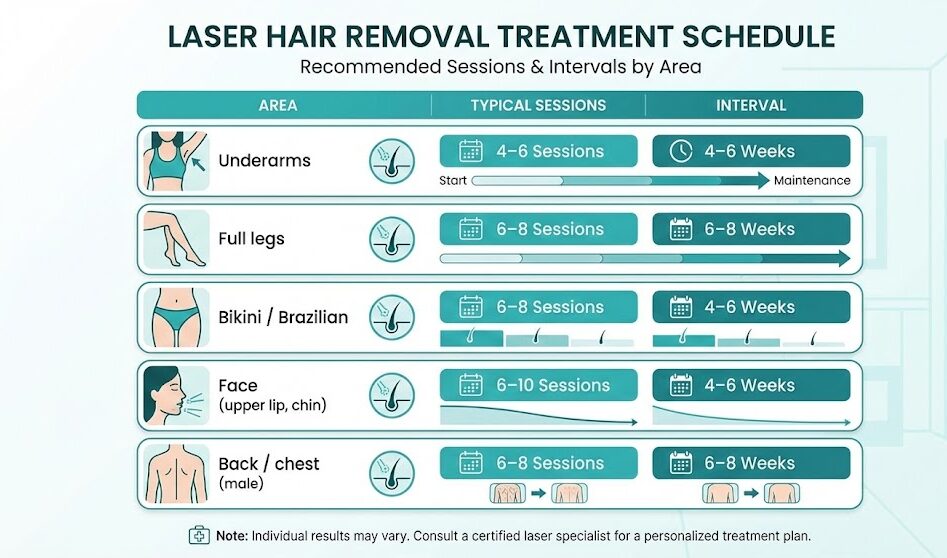
Most people need 6–8 laser hair removal sessions spaced 4–8 weeks apart to achieve 80–90% permanent hair reduction on face and body areas.
This is the question every new patient asks — and the honest answer is that it depends on several variables.
Why multiple sessions are required: Hair grows in cycles. At any given moment, only 20–30% of your hair is in the active anagen (growth) phase — the only phase where laser energy can effectively damage the follicle. Sessions are spaced to catch each wave of follicles as they enter this phase.
Typical session ranges by area:
| Area | Typical Sessions | Interval |
|---|---|---|
| Underarms | 4–6 | 4–6 weeks |
| Full legs | 6–8 | 6–8 weeks |
| Bikini / Brazilian | 6–8 | 4–6 weeks |
| Face (upper lip, chin) | 6–10 | 4–6 weeks |
| Back / chest (male) | 6–8 | 6–8 weeks |
Factors that affect the number of sessions: Hormonal conditions like PCOS can require additional sessions. Hair color (lighter hair responds more slowly), hair thickness, and treatment consistency all play a role. Patients who miss sessions or exceed recommended intervals often need more treatments.
How Much Does Laser Hair Removal Cost in Dubai?
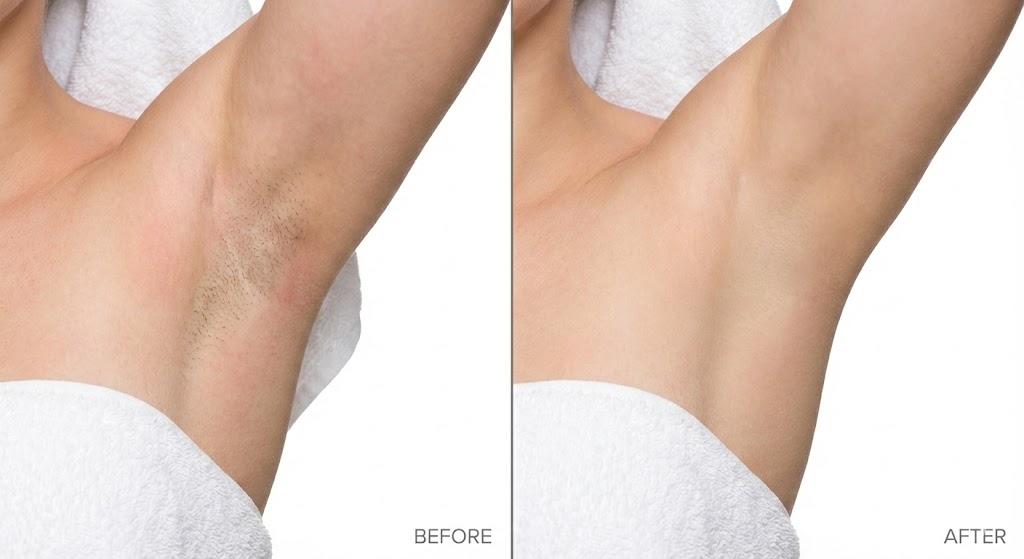
Laser hair removal in Dubai typically costs AED 200–800 per session depending on the treatment area, laser type, and clinic — with package deals offering better value.
Cost is one of the first things people want to know — and it varies more widely than most expect.
Why prices vary in Dubai:
The type of laser technology used, the clinic’s licensing and accreditation, the experience of the practitioner, and the size of the treatment area all affect pricing. Budget clinics often use outdated technology or non-medical staff — which creates both safety risks and suboptimal results.
What to look for beyond the price:
A reputable clinic in Dubai will have DHA-licensed practitioners performing or supervising all laser procedures. They will conduct a patch test and skin assessment before your first session. They will use FDA-cleared or CE-marked laser equipment. They will provide a consultation — not just a booking.
At Rere Polyclinic, we offer free consultations where our doctors assess your skin type, hair profile, and medical history before recommending a treatment plan. This is the standard that protects patients — and it’s the standard you should expect from any clinic you consider.
Is Laser Hair Removal Painful?
Most patients describe laser hair removal as mild snapping or warmth — not painful. Modern systems with cooling technology make the experience significantly more comfortable.
Pain tolerance varies, but “painful” is rarely how patients describe the experience with modern technology.
Older laser systems delivered heat without any mitigation. Current systems integrate contact cooling, cryogen sprays, or built-in cooling plates that protect the skin surface and dramatically reduce discomfort during the pulse.
Sensitive areas — the upper lip, bikini line, and underarms — tend to feel more intense than legs or back. Most patients rate discomfort at 2–4 out of 10.
What helps reduce discomfort: Avoiding sun exposure for two weeks before treatment keeps the skin less reactive. Shaving 24 hours before (as recommended by your technician) means less surface hair absorbing energy unnecessarily. Some patients apply a topical numbing cream before sessions for sensitive areas — your doctor can advise if this is appropriate for you.
What Are the Side Effects and Risks?
Common laser hair removal side effects include temporary redness and swelling lasting 24–48 hours. Serious risks like burns or scarring are rare with DHA-licensed practitioners.
Laser hair removal has an excellent safety profile when performed correctly. Understanding the difference between expected reactions and actual complications is important.
Normal reactions (expected and temporary):
- Redness around treated follicles (1–24 hours)
- Mild swelling similar to a sunburn sensation
- Slight sensitivity in the treated area
- Small red bumps that resolve within 24–48 hours
Less common but possible:
- Temporary hyperpigmentation (darkening) — more likely on darker skin with incorrect laser settings
- Temporary hypopigmentation (lightening) — rare
- Blistering or burns — almost exclusively the result of incorrect settings or untrained operators
The most important risk factor is the operator. Burns, scarring, and pigmentation changes in laser hair removal are almost universally linked to incorrect treatment parameters — wrong laser type for the skin tone, fluence too high, or sessions on tanned skin. This is why DHA licensing and clinical oversight matter.
What Should You Do Before and After Each Session?
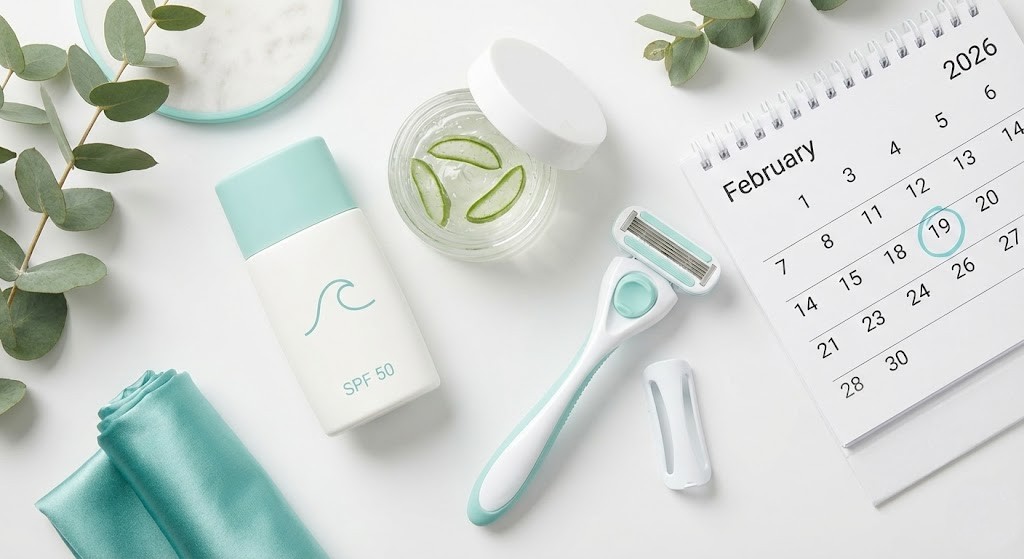
Before laser, avoid sun exposure and waxing for 2–4 weeks and shave 24 hours prior. After, avoid heat, sun, and harsh products for at least 48 hours post-session.
Before your session:
- Avoid direct sun exposure for at least 2 weeks beforehand
- Do not wax, thread, or use depilatory creams (these remove the root the laser targets)
- Shave the treatment area 24 hours before your appointment
- Avoid self-tanning products for 2 weeks
- Inform your doctor of any medications, especially photosensitizing drugs
After your session:
- Avoid sun exposure for a minimum of 48–72 hours
- Apply SPF 50 to treated areas if they will be exposed
- No hot showers, saunas, or intense exercise for 24–48 hours
- Do not apply perfumed products or retinols to treated areas for 48 hours
- Hair will appear to “shed” over the following 2–3 weeks — this is the expected result, not regrowth
Frequently Asked Questions
Is laser hair removal permanent?
Laser hair removal delivers permanent reduction — typically 80–90% reduction in hair growth after a full course of sessions. Fine regrowth may occur over years, and occasional maintenance sessions can address this.
Can I have laser hair removal during summer in Dubai?
Yes, with precautions. Tanned skin increases the risk of pigmentation side effects. It’s essential to protect the treatment area from sun exposure for at least 2 weeks before each session. Your doctor will assess your skin tone at each visit before proceeding.
Does laser hair removal work on blonde or white hair?
No. Laser targets melanin — the pigment in hair. Blonde, red, grey, and white hair have little to no melanin, which means laser energy has nothing to target. These hair types do not respond well to standard laser hair removal.
How soon do I see results?
Most patients notice a reduction in hair density after the second or third session. Hair in the treated follicles sheds over 2–3 weeks post-treatment. Full results are visible after completing the recommended course of sessions.
Is laser hair removal safe during pregnancy?
No. Laser hair removal is not recommended during pregnancy. While there is limited evidence of direct harm, the procedure is electively cosmetic, and the precautionary principle applies. Most reputable clinics — including ours — decline to treat pregnant patients.
What makes Rere Polyclinic different for laser hair removal in Dubai?
Our team of DHA-licensed doctors selects the appropriate laser system for your specific skin tone and hair type. We conduct proper clinical assessments before every treatment series, not just a booking. Our protocols follow current clinical evidence — including appropriate intervals, patch testing, and post-care guidance. We never rush sessions or override safety margins.
Conclusion: What You Should Know Before You Book
Laser hair removal works. The science is established, the technology has improved enormously, and results for the right candidates — treated by qualified professionals with the right equipment — are consistently excellent.
The most important decision you make isn’t which body area to start with. It’s choosing the right clinic.
In Dubai, where aesthetic clinics range from medically supervised to unlicensed basement operations, DHA licensing and clinical oversight are the minimum standards you should require. A free consultation is not just a sales call — it’s an opportunity for a doctor to evaluate whether you’re a suitable candidate, which laser is right for your skin, and what realistic results look like for your specific hair profile.
Ready to start? Book a free consultation with the DHA-licensed doctors at Rere Polyclinic Dubai Jumeirah. We’ll assess your skin type, design a treatment plan, and answer every question before you commit to a single session.
[…] treatments in Dubai, as UV index drops to 4–7, reducing post-treatment PIH risk and allowing laser and peel treatments to deliver full […]