Fillers vs Botox: Complete Comparison Guide (Which is Right for You?)
Fillers vs Botox — what's the difference? Compare how they work, results, costs in Dubai, and longevity. Free consultation at Rere Polyclinic Dubai.
Byadmin

You have decided you want a subtle refresh. Maybe it is the fine lines on your forehead that bother you. Maybe your cheeks have lost their fullness. Either way, one question keeps coming up — should you get Botox or dermal fillers?
This is the most common question we hear from patients at Rere Polyclinic, our DHA-licensed aesthetic clinic in Dubai, Jumeirah 1. And the answer is simpler than you think once you understand what each treatment actually does.
Both Botox and fillers are safe, non-surgical injectable treatments that deliver visible results with minimal downtime. But they solve completely different problems. This guide breaks down the differences so you can walk into your consultation feeling informed and confident.
Let us show you exactly which one is right for your concerns.
What Is the Main Difference Between Botox and Dermal Fillers?
Botox relaxes muscles to smooth expression lines while dermal fillers restore lost volume — two different tools for two different aging concerns.
Here is the simplest way to understand it. Botox is a neuromodulator made from botulinum toxin. It works by temporarily blocking nerve signals to specific facial muscles. When those muscles stop contracting, the wrinkles they create soften and smooth out.
According to the American Society of Plastic Surgeons (ASPS), Botox remains the most popular non-surgical cosmetic treatment worldwide, with over 7 million procedures performed annually in the United States alone.
Dermal fillers work differently. They are gel-like substances — most commonly made from hyaluronic acid, a molecule your body already produces — that are injected beneath the skin to add volume and fullness. Think of Botox as a muscle relaxer and fillers as a volume restorer.
The wrinkles each one treats are also different.
What Are Dynamic Wrinkles?
Dynamic wrinkles appear when you move your face. The lines on your forehead when you raise your eyebrows, the creases between your brows when you frown, and crow’s feet when you smile — these are all dynamic wrinkles caused by repeated muscle movement. Botox treats these.
What Are Static Wrinkles?
Static wrinkles are visible even when your face is completely at rest. Hollow cheeks, thin lips, deep nasolabial folds (the lines from your nose to your mouth), and marionette lines around the chin — these result from natural volume loss as we age. Dermal fillers treat these.
At Rere Polyclinic, our board-certified aesthetic doctors assess your facial anatomy to determine which wrinkle type is causing your concern before recommending any treatment.
Which Treatment Areas Does Each One Target Best?
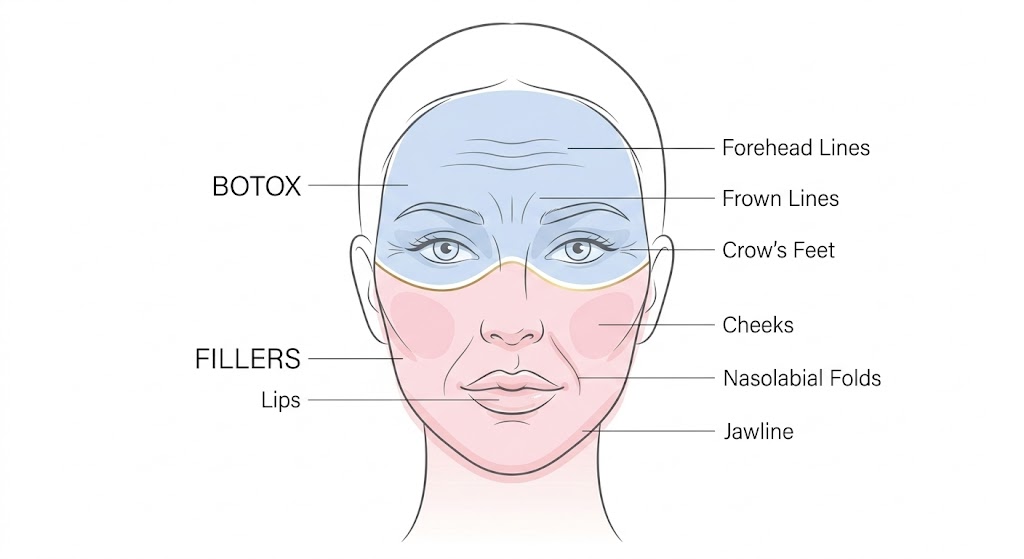
Botox works best on the upper face for forehead lines, frown lines, and crow’s feet, while fillers target cheeks, lips, jawline, and nasolabial folds.
Understanding where each treatment excels helps you set realistic expectations. Clinical research confirms that Botox delivers the strongest results in the upper third of the face, while fillers perform best in the mid-face and lower face.
Here is a quick breakdown:
Best Treatment Areas for Botox
Botox is most commonly used for:
- Forehead lines — horizontal creases across the forehead (typically 10-30 units)
- Frown lines (glabella) — the vertical “11” lines between your brows (typically 20-25 units)
- Crow’s feet — fine lines at the outer corners of your eyes (typically 12-20 units per side)
- Bunny lines — creases on the sides of the nose
- Lip flip — subtle relaxation of the upper lip for a fuller appearance
- Jawline slimming (masseter Botox) — popular in Dubai for facial contouring
Other FDA-approved uses include treating excessive sweating (hyperhidrosis), chronic migraines, and TMJ discomfort.
Best Treatment Areas for Dermal Fillers
Fillers excel in areas where volume has been lost:
- Cheeks — restoring youthful fullness and mid-face lift
- Lips — adding volume, definition, and symmetry
- Nasolabial folds — softening the “parentheses” lines from nose to mouth
- Marionette lines — lifting the corners of the mouth
- Under-eye hollows (tear troughs) — reducing dark circles caused by volume loss
- Jawline and chin — sculpting and contouring for facial balance
- Temples — restoring volume to hollow temple areas
Popular filler brands used in Dubai include Juvederm, Restylane, and Sculptra, each designed for specific areas and concerns. At Rere Polyclinic, we use only pharmaceutical-grade, CE-marked, or FDA-cleared injectable products administered by DHA-licensed aesthetic doctors.
How Long Do Botox and Filler Results Last?
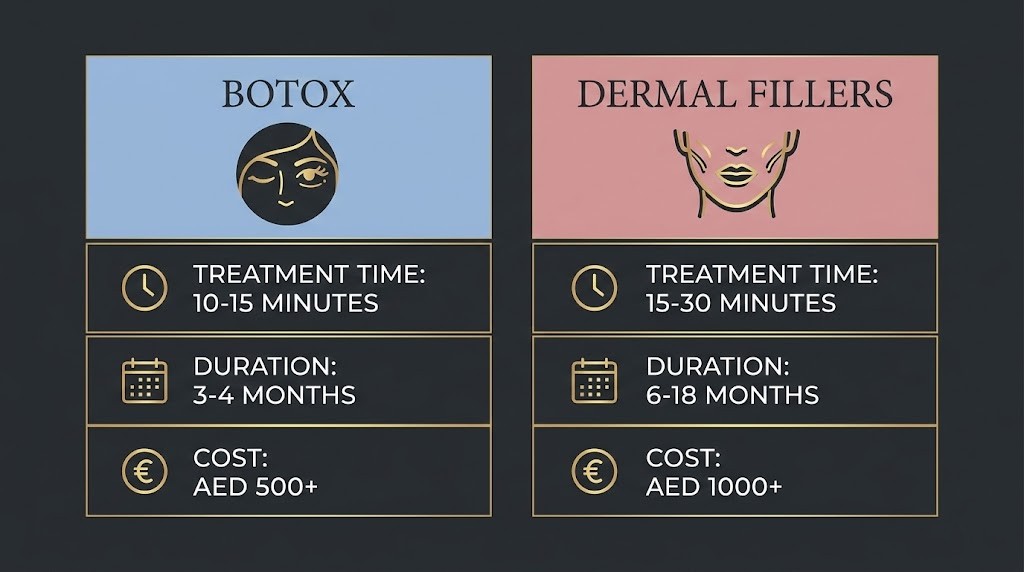
Botox results typically last 3-4 months on average, while dermal fillers maintain their effect for 6 to 18 months, depending on the product and placement.
Longevity is one of the biggest deciding factors for patients choosing between these two treatments.
With Botox, most patients see results within 3-7 days after injection. The full smoothing effect appears at around 2 weeks and lasts 3-4 months before the muscle activity gradually returns. Some patients report results lasting up to 6 months with regular maintenance treatments, as the muscles become trained to relax over time.
Dermal fillers provide more immediate results. You can see the added volume right after treatment, though minor swelling may take a few days to settle. Depending on the filler type, results last:
- Hyaluronic acid fillers (Juvederm, Restylane): 6-12 months
- Calcium hydroxylapatite (Radiesse): 12-18 months
- Poly-L-lactic acid (Sculptra): Up to 2 years (stimulates collagen production)
Factors That Affect How Long Results Last
Several factors influence treatment duration. Your metabolism plays a major role — people with faster metabolisms may break down both Botox and filler products more quickly. The treatment area matters too. Fillers in high-movement areas like the lips tend to dissolve faster than those in the cheeks. Dosage, injection technique, and product quality also affect longevity.
Dubai’s active lifestyle does not negatively impact Botox results. The treatment works at the nerve-muscle junction through a temperature-independent biological process, so heat and humidity do not affect how long your results last.
When to Schedule Maintenance Treatments
For Botox, most patients at Rere Polyclinic schedule maintenance every 3-4 months. For fillers, we typically recommend a follow-up assessment at 9-12 months. Your aesthetic doctor will create a personalized maintenance schedule based on how your body responds.
How Much Do Botox and Fillers Cost in Dubai?
Botox in Dubai typically costs AED 500-2,500 per session while dermal fillers range from AED 1,000-3,500 per syringe, depending on brand and area.
Pricing varies across Dubai’s 200+ aesthetic clinics, and understanding what drives the cost helps you make a smarter investment in your appearance.
Botox Cost Breakdown in Dubai
Botox is priced either per unit or per treatment area. Per-unit pricing in Dubai ranges from AED 30 to 50 per unit at reputable clinics. A typical treatment session might look like this:
- Forehead lines: AED 800-1,500 (10-30 units)
- Frown lines: AED 600-1,250 (20-25 units)
- Crow’s feet: AED 500-1,000 (12-20 units per side)
- Full upper face: AED 1,500-2,500 (40-60 units)
Dermal Filler Cost Breakdown in Dubai
Fillers are priced per syringe. One syringe (typically 1ml) ranges from AED 1,000 to AED 3,500 depending on the brand and product line:
- Lip fillers: AED 1,200-2,500 (1 syringe)
- Cheek fillers: AED 2,000-3,500 (1-2 syringes)
- Nasolabial folds: AED 1,500-3,000 (1-2 syringes)
- Jawline contouring: AED 2,500-5,000 (2-3 syringes)
Why premium clinics cost more: DHA-licensed clinics with board-certified aesthetic doctors, FDA-cleared products, and proper medical protocols charge more than discount providers — but the safety, precision, and natural-looking results justify the investment.
Nadia, a 36-year-old marketing professional in JBR, told us she switched to Rere Polyclinic after a bad filler experience at a budget clinic:
“The difference was night and day. My doctor actually assessed my facial structure and explained exactly what I needed. The results looked natural — my friends just said I looked refreshed.”
Can You Combine Botox and Fillers Together?
Yes, combining Botox with fillers — often called a liquid facelift — addresses both expression lines and volume loss for full facial rejuvenation.
This is actually one of the most effective approaches in modern aesthetic medicine, and it is increasingly what our patients at Rere Polyclinic request.
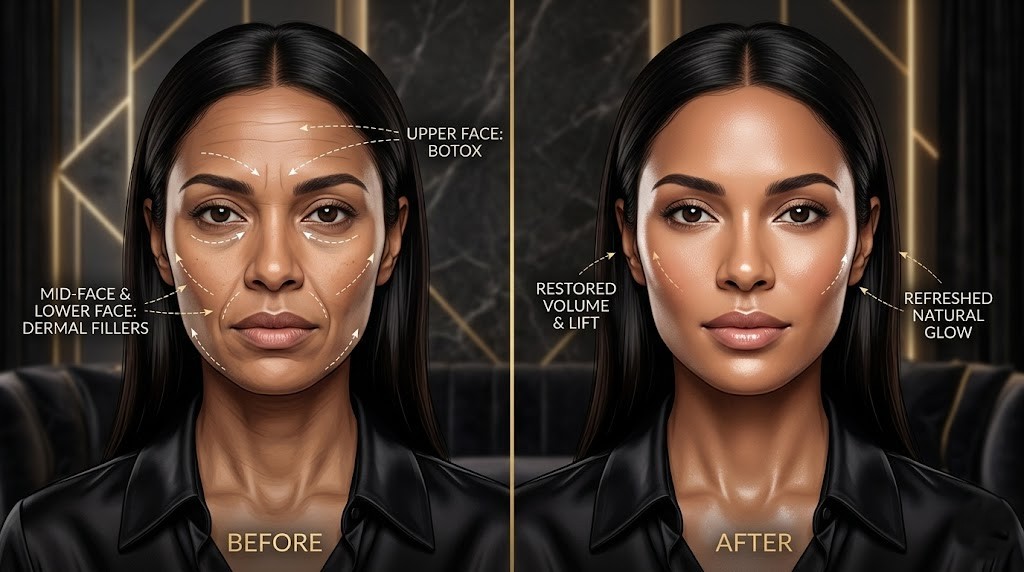
A liquid facelift uses Botox to relax the muscles, creating expression lines in the upper face while strategically placing fillers to restore volume and contour the mid-face and lower face. The combination delivers a full-face refresh that looks natural and balanced.
What Is a Liquid Facelift?
The term “liquid facelift” refers to a non-surgical combination of injectables that mimics some of the lifting and smoothing effects of a surgical facelift — without the incisions, general anesthesia, or weeks of recovery. According to clinical data, patient satisfaction rates for combination treatments consistently exceed those of single-treatment approaches.
Amira, a 42-year-old entrepreneur from Dubai Jumeirah 1, came to Rere Polyclinic wanting to address her forehead lines and hollowed cheeks.
“I thought I needed to pick one or the other. My doctor recommended Botox for the forehead and a small amount of cheek filler. The whole thing took 30 minutes, and I was back at work the same day. I looked five years younger without looking ‘done.'”
How Your Doctor Creates a Personalized Treatment Plan
Every face is different. A skilled aesthetic doctor will assess your bone structure, skin quality, muscle activity, and volume loss before recommending a treatment plan.
At Rere Polyclinic, our DHA-licensed doctors create personalized injectable plans during a comprehensive consultation — we never take a one-size-fits-all approach.
The consultation is free, and there is no pressure to proceed with treatment on the same day.
Which Injectable Treatment
Is Right For You?
Answer 4 quick questions. Get a personalised recommendation from our DHA-licensed aesthetic doctors.
Takes 30 seconds · No email required
What is your primary concern?
Which areas bother you the most?
Have you had injectables before?
When are you looking to start?
Botox
Based on your answers…
Frequently Asked Questions About Fillers vs Botox in Dubai
Q1: Is Botox or filler more painful?
Both treatments involve minimal discomfort — most patients describe Botox as small pinches and fillers as mild pressure eased by topical numbing.
Botox injections use very fine needles and take only 10-15 minutes. Most patients say it feels like a quick pinch. Filler injections may involve slightly more pressure, but most modern filler products contain lidocaine (a built-in numbing agent) for comfort. At Rere Polyclinic, we apply topical anesthetic cream before both treatments to ensure a comfortable experience.
Q2: Can I get Botox and fillers on the same day?
Yes, Botox and fillers can be safely administered during the same appointment, which is a common practice at reputable aesthetic clinics across Dubai.
Many patients choose to combine both treatments in a single visit to save time. Your aesthetic doctor will typically start with Botox, then proceed with fillers. There is no medical reason to separate the two treatments into different appointments, and combining them allows your doctor to create a more balanced, cohesive result.
Q3: What age should you start Botox or fillers?
Most patients begin Botox in their late 20s to early 30s for prevention, and fillers in their mid-30s when volume loss becomes noticeable.
There is no single “right” age. Preventive Botox (sometimes called “baby Botox”) has become popular among patients in their late 20s who want to slow down wrinkle formation before deep lines set in. Filler treatments are more common starting in the mid-30s, when natural volume loss in the cheeks, lips, and under-eye area begins to show. Your DHA-licensed aesthetic doctor can advise whether you are a good candidate based on your skin quality and concerns.
Q4: Are Botox and fillers safe in Dubai clinics?
Yes, both treatments are safe when administered by DHA-licensed doctors using FDA-cleared or CE-marked products in regulated clinic settings.
The Dubai Health Authority (DHA) requires all medical aesthetic clinics to operate under a licensed facility permit and employ qualified medical practitioners. Always verify that your clinic holds a valid DHA license and that your injector is a board-certified doctor or licensed aesthetic practitioner. Rere Polyclinic maintains full DHA compliance, and all injectable treatments are performed exclusively by our licensed aesthetic doctors.
Q5: How do I choose between Botox and fillers for my first treatment?
Book a consultation with a board-certified aesthetic doctor who can assess your facial structure, identify your concerns, and create the right plan.
The best way to choose is not to guess — it is to get a professional assessment. During a consultation at Rere Polyclinic, your doctor will evaluate whether your concern involves muscle-driven wrinkles (Botox territory), volume loss (filler territory), or both. Many first-time patients start with Botox because it is quicker, more affordable, and gives a great introduction to injectables with natural-looking results.
The Bottom Line: Botox and Fillers Solve Different Problems
Botox and dermal fillers are both powerful anti-aging tools, but they are not interchangeable. Botox smooths expression lines by relaxing muscles. Fillers restore lost volume and contour your facial structure. The best results often come from combining both treatments strategically.
At Rere Polyclinic in Dubai, Jumeirah 1, our DHA-licensed aesthetic doctors help you understand exactly what your face needs — no guesswork, no pressure, and no cookie-cutter treatment plans.