
Why Sunscreen is Non-Negotiable in UAE: Expert Dermatologist Explains
Dubai UV index hits extreme levels year-round. A DHA-licensed dermatologist explains why SPF 50+ sunscreen is your skin's most essential daily habit.
Byadmin
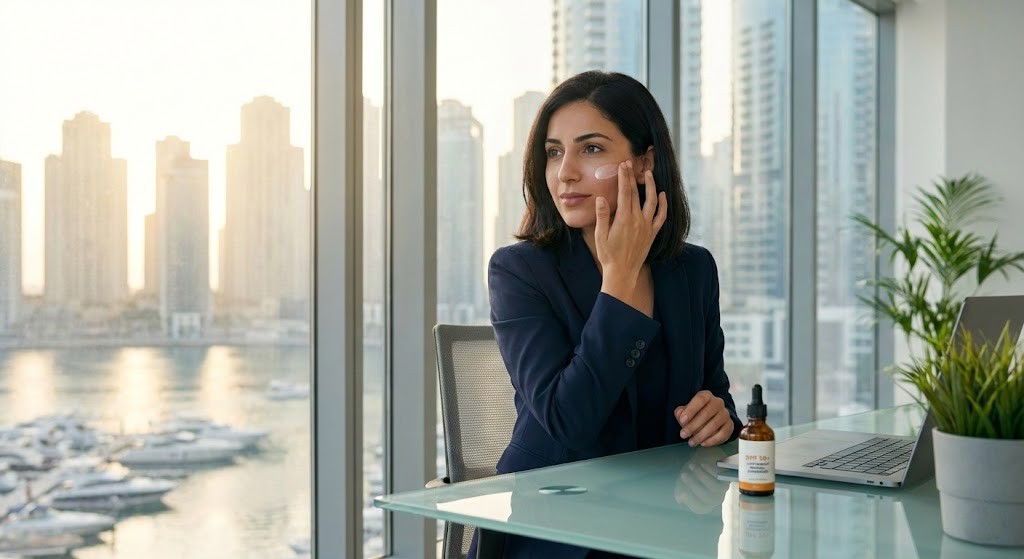
“Do I really need sunscreen every single day? Even in the car? Even in winter?”
Nadia, a 34-year-old professional working out of DIFC, asked this during her consultation at Rere Polyclinic. She’d been diligently applying SPF 30 before beach weekends at JBR, but honestly — winter? Cloudy days? Driving to meetings?
The answer surprised her. And it might surprise you too.
Dubai’s sun isn’t seasonal. It doesn’t respect seasons, cloud cover, or glass windows. The UAE sits close to the Tropic of Cancer, which means UV radiation arrives year-round at intensities that would alarm most dermatologists abroad. The consequences accumulate quietly — years of unnoticed damage that eventually shows up as premature wrinkles, pigmentation, and in serious cases, skin cancer.
At Rere Polyclinic Dubai, our DHA-licensed dermatologists see the long-term impact of skipped sunscreen daily. This guide explains what’s actually at stake — and how to protect yourself properly.
What Makes UAE’s Sun Uniquely Dangerous for Your Skin?
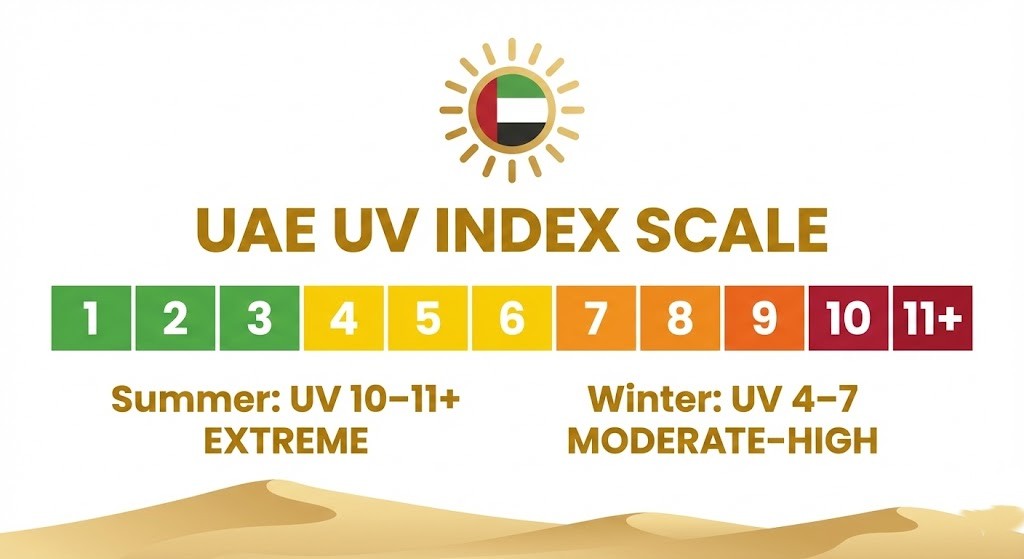
UAE’s UV index regularly reaches levels 10–11+ (classified as “extreme”) for most of the year, meaning unprotected skin can sustain damage in as little as 10 minutes of direct exposure.
Dubai sits at latitude 25°N — near the Tropic of Cancer — giving the city almost perpendicular sun angles that maximize UV intensity. In summer months, the UV index exceeds 11, which the World Health Organization classifies as extreme.
But here’s what catches residents off guard: even in January, Dubai’s UV index hovers between 4 and 7. Moderate to high. Enough to cause cumulative damage with daily commutes and outdoor lunch breaks that never trigger a mental “sunscreen alarm.”
There’s also the reflection problem. Dubai’s white sand beaches, glass towers, and light-coloured architecture all reflect UV rays, compounding exposure in ways that feel invisible in the moment but accumulate over years.
According to the UAE National Cancer Registry, skin cancer is now the fourth most common cancer in the country, with approximately 400 new cases diagnosed annually. A study published in PMC examining UAE skin cancer patterns found that skin cancer represents 14.5% of all male malignancies locally — numbers that track directly with the region’s intense sun exposure.
Our DHA-licensed dermatologists at Rere Polyclinic emphasize that these figures aren’t meant to alarm, but they do demand daily habit changes.
UVA rays make this especially complicated. They penetrate clouds. They pass through glass. That 45-minute morning commute with the sun on your left cheek? That’s UVA exposure. Concentrated, daily, slow-burning. The kind that drives premature aging without ever causing a sunburn you’d notice.
How Much Sun Damage Has Your
Skin Already Collected in the UAE?
Answer 5 quick questions. Get your personalised skin-risk score from our DHA-licensed dermatologists.
Does Daily Sunscreen Actually Prevent Skin Aging?
Yes. Research published in the Annals of Internal Medicine found that daily sunscreen users showed 24% less skin aging than those who applied it sporadically — with measurable improvements in texture and pigmentation.
The skincare industry often makes promises that clinical research can’t support. Sunscreen is different. The landmark randomized controlled trial — conducted with 903 adults over four years — gave dermatologists what they’d long suspected: daily SPF use significantly retards photoaging, measurably and reproducibly.
Participants who used broad-spectrum sunscreen daily were 24% less likely to develop visible aging signs compared to those who used it only occasionally.
The science behind it is straightforward. UVA radiation degrades collagen and elastin — the structural proteins that keep skin firm and resilient. Research in the journal Photodermatology, Photoimmunology & Photomedicine confirms that consistent broad-spectrum protection significantly reduces wrinkles and uneven pigmentation across all skin types and ethnic backgrounds.
For Dubai residents, who accumulate this UV load year-round rather than seasonally, the protective gap between “daily user” and “occasional user” is wider than anywhere else.
This is why sunscreen earns its title as the world’s most evidence-backed anti-aging product — not retinol, not vitamin C serums, not expensive peptide creams. Sun protection is the foundation everything else builds on.
Our team frequently combines sunscreen recommendations with aesthetic treatments at Rere Polyclinic to protect and extend treatment results — because even the best Botox or filler won’t last if daily UV damage continues to degrade collagen beneath the surface.
Who Actually Needs Sunscreen in the UAE — Can Darker Skin Skip It?
Everyone living in the UAE needs daily SPF 50+ sunscreen, regardless of skin tone. Darker skin types face lower sunburn risk but equal vulnerability to UV-driven pigmentation, melasma, and long-term photo-damage.
This is perhaps the most persistent misconception we hear at the clinic: “I’m South Asian / Arab / African — I don’t burn, so I don’t need it.” The logic sounds reasonable. It’s incorrect.
Melanin does provide some natural UV protection, and Fitzpatrick V–VI skin types burn far less readily than Fitzpatrick I–II. But UVA rays — the ones responsible for aging and pigmentation — affect melanin-rich skin differently, not less. They drive melasma, post-inflammatory hyperpigmentation, and uneven skin tone. If you’ve noticed dark patches on your cheeks, forehead, or around your mouth, cumulative UVA exposure is almost certainly a contributing factor.
Dr. Anwar Al Hammadi, Consultant and Head of Dermatology at the Dubai Health Authority, has specifically noted that darker-skinned residents in the UAE shouldn’t interpret their sun-tolerance as sun immunity — the risks simply manifest differently. A cross-sectional study of UAE residents found that only 35.6% reported consistently using broad-spectrum SPF 30+. That’s a meaningful protection gap.
For UAE’s multicultural, internationally diverse population — from fair-skinned European expats to South Asian professionals to Emirati nationals — SPF 50+ broad-spectrum protection is the universal recommendation. Not SPF 30. Not makeup with SPF. A dedicated facial sunscreen applied properly, every morning.
How Should You Apply Sunscreen in Dubai’s Heat and Humidity?
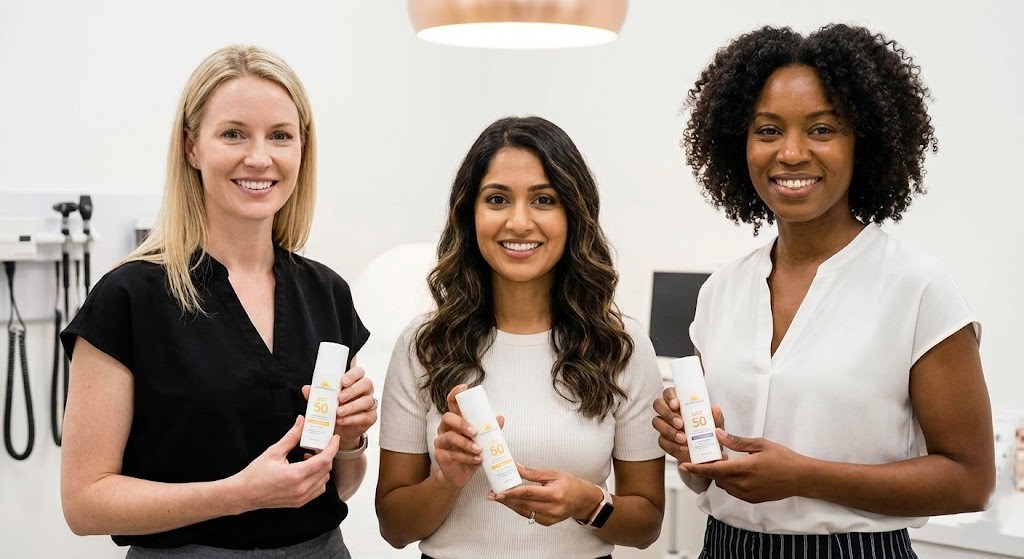
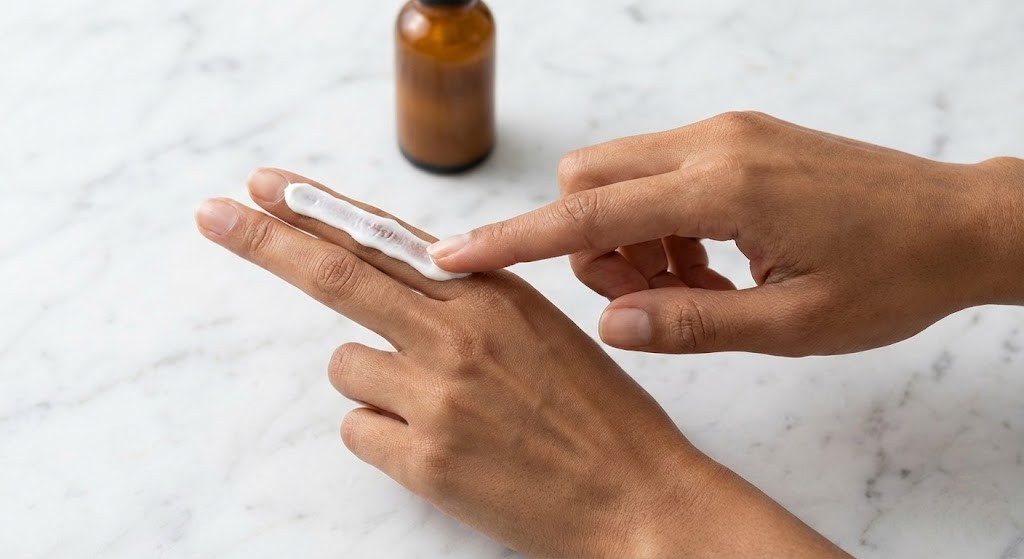
Apply 1/4 teaspoon (about two finger-lengths) of SPF 50+ broad-spectrum sunscreen to your face and neck every morning. Reapply every two hours if outdoors, after sweating heavily, or after swimming.
Application mistakes undermine even the best products. The two most common errors in Dubai: applying too little, and not reapplying. Most people use a fraction of the amount needed for the SPF on the label to work. Dermatologists recommend the “two-finger rule” — squeeze sunscreen across the length of both index and middle fingers. That’s your face and neck dose.
Dubai’s climate demands some specific product choices too. High humidity and heat make thick, greasy formulas uncomfortable and impractical. Look for:
- Lightweight gels or fluid textures — these don’t feel suffocating at 42°C
- PA++++ rating — confirms high UVA protection beyond basic SPF
- Non-comedogenic formulas — important for pores that work harder in desert heat
- Water resistance — relevant for outdoor activities, beach days at JBR, or humid summer mornings
And yes — sunscreen indoors matters. UVA rays pass through glass, which means a north-facing office in the Dubai Jumeirah or a car ride on Sheikh Zayed Road still exposes your skin. Window-side desks are the reason many of our patients develop uneven pigmentation on one side of their face.
A HydraFacial treatment can help address existing UV-related pigmentation and congestion while boosting your skin’s ability to benefit from topical protection — but sustained daily SPF remains the most important step before and after any treatment.
What Happens to Skin When You Skip Sunscreen in the UAE Long-Term?
Consistent sun exposure without SPF protection accelerates visible aging by 10–20 years and significantly raises risk for skin cancer, melasma, and deep pigmentation that topical treatments struggle to reverse.
The damage isn’t dramatic at first. A slightly dull texture here, a faint dark patch there. Then the collagen loss begins accumulating into real wrinkles that deepen faster than they should.
Dermatologists call it photoaging — the fraction of skin aging caused directly by UV exposure rather than chronological age. Research from PMC’s photoaging review quantifies this as roughly 80–90% of visible aging signs being attributable to UV damage rather than the passage of time.
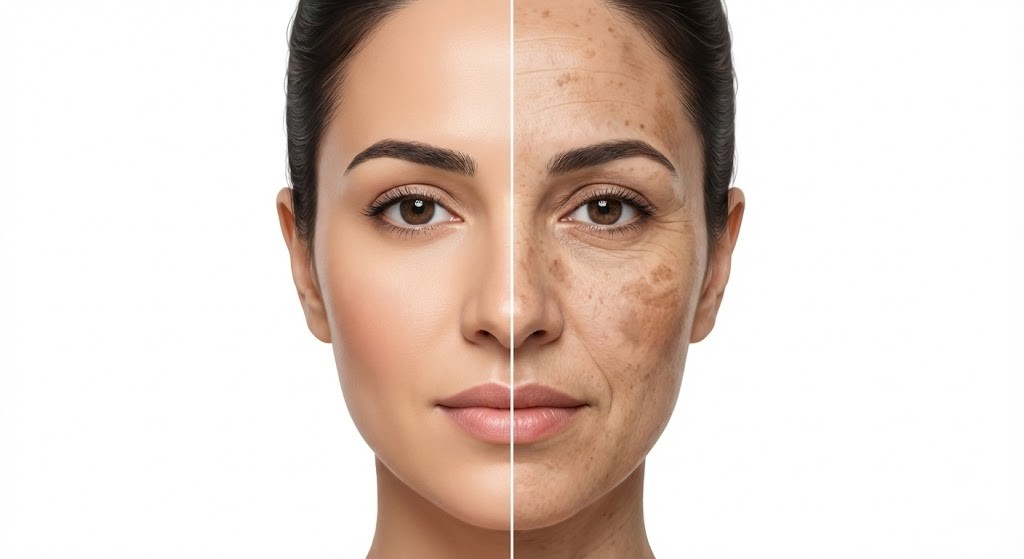
In the UAE’s intensity, this timeline compresses. Residents who’ve lived here without daily SPF for 5–10 years often present with skin that appears a decade older than their chronological age. Melasma, particularly challenging to treat, develops when cumulative UV exposure triggers melanocyte hyperactivity — and the UAE’s year-round sun provides constant fuel for that process.
The encouraging part? It’s largely preventable. And for existing damage, it’s partially reversible with the right combination of daily SPF and professional treatment.
Our dermatologists develop personalized sun-damage management plans, combining sunscreen recommendations with evidence-based topical protocols and clinic treatments where appropriate. The treatment works better — and lasts longer — when daily photoprotection is consistent.
Frequently Asked Questions About Sunscreen in UAE
Is SPF 30 enough for Dubai, or do I need SPF 50?
DHA-licensed dermatologists consistently recommend SPF 50+ for UAE residents. SPF 30 blocks ~97% of UVB rays; SPF 50 blocks ~98%. In Dubai’s extreme UV conditions, that 1% matters year-round.
In most European climates, SPF 30 is considered adequate for daily use. Dubai isn’t most climates. Year-round UV intensity — including winter months with UV indices of 4–7 — means the marginal benefit of SPF 50 adds up meaningfully over thousands of daily exposures. More importantly, most people apply less than the tested dose anyway, which means SPF 50 provides real-world protection closer to what SPF 30 promises in lab conditions.
Does sunscreen in makeup give adequate protection?
No. Makeup with SPF cannot replace dedicated sunscreen. The amount of foundation needed to reach labeled SPF would be far more than anyone realistically applies to their face daily.
Foundation provides a thin, uneven layer of coverage. Even if the formula contains SPF 30, the actual protective dose delivered to your skin is a fraction of what clinical testing uses. Apply a dedicated SPF 50+ facial sunscreen as the final step before primer, let it absorb for 2–3 minutes, then apply makeup as normal.
Do I need to wear sunscreen in the car?
Yes. UVA rays penetrate standard car glass, causing cumulative sun damage even during commutes. If you drive regularly, a daily SPF 50 on exposed skin is essential.
Car windshields do block a portion of UVA radiation, but side windows do not. Daily commuters who drive with the sun at a particular angle often develop asymmetric pigmentation — darker, more wrinkled skin on the sun-facing side. It’s subtle at first, and unmistakable after years.
Can sunscreen prevent melasma in Dubai?
Broad-spectrum SPF 50+ with UVA protection (PA++++) is the most effective prevention for melasma. Without consistent daily sunscreen, even successful treatments tend to relapse quickly in Dubai’s intense sun.
Melasma is driven by UV exposure stimulating excess melanin production. Once developed, it’s notoriously difficult to treat — and nearly impossible to maintain results without strict daily photoprotection. For darker skin types who are particularly prone to melasma, mineral sunscreens containing iron oxide provide additional visible light protection.
Is year-round sunscreen really necessary in UAE, even in winter?
Yes. Even in December and January, Dubai’s UV index reaches 4–7, classified as moderate to high risk. Year-round SPF protection is the dermatologist standard recommendation for all UAE residents.
Winter in Dubai feels comfortable — cooler, lower humidity, genuinely pleasant outdoor weather. That comfort is deceptive in terms of UV exposure. The sun remains at UV Index 4+ for most of the cooler months, enough to cause cumulative damage, worsening pigmentation, and ongoing collagen degradation with repeated unprotected exposure.
The Bottom Line on Sunscreen in UAE
Daily sunscreen isn’t a beauty routine add-on. It’s the single most effective skin health decision you can make living in the UAE. The research is unambiguous: consistent SPF 50+ use measurably slows aging, reduces skin cancer risk, prevents pigmentation, and protects the results of any professional skin treatment you invest in.
Nadia — the professional from DIFC we mentioned earlier — now keeps an SPF 50 on her desk and in her car. Six months later, her dermatologist noted measurable improvement in existing sun spots and pigmentation, without any other treatment change. Just consistent daily protection.
Ready to build a sun-protection routine that actually works for your skin type? Our DHA-licensed dermatologists at Rere Polyclinic Dubai offer personalized skin consultations, addressing existing sun damage and creating a prevention plan tailored to your skin type, lifestyle, and Dubai’s specific UV demands.
Book your free skin consultation at Rere Polyclinic — located in jumeirah 1 Al wasl Road Dubai, 5 minutes from Dubai Mall Metro Station.